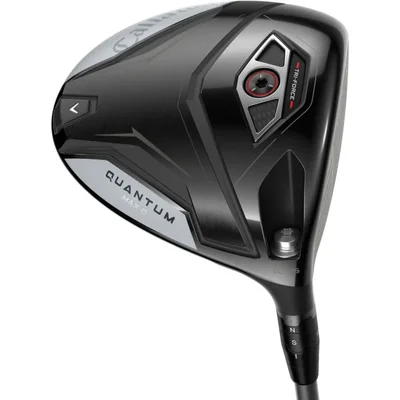
Callaway Quantum Max D Driver
Callaway's most forgiving, draw-biased driver in the 2026 Quantum family. Built for slicers and high handicappers who want to keep the ball in the fairway without sacrificing ball speed. The Tri-Force face and internal heel weighting deliver a genuine draw bias that multiple reviewers call stronger than Callaway advertises.
We may earn a commission if you buy through this link — it never affects our scores or the price you pay.
The consensus
The Callaway Quantum Max D is the most forgiving, highest-launching driver in Callaway's 2026 Quantum family, purpose-built for golfers who fight a slice. The 'D' stands for Draw, and every reviewer confirms it delivers: internal heel weighting and a slightly more upright lie angle produce a genuine draw bias that multiple sources call stronger than Callaway's 'slight draw' marketing suggests. Combined with the Tri-Force face — an industry-first layering of ultra-thin titanium, Poly Mesh, and carbon fiber — the Max D retains impressive ball speed even on off-center strikes.
Where sources agree strongly: the Max D is exceptionally forgiving, surprisingly fast for a draw driver, and has a solid, powerful feel at impact. National Club Golfer recorded ball speeds around 160+ mph and carry distances over 280 yards — numbers that rival non-draw models. Golf Monthly found it only 2 mph behind the Triple Diamond in ball speed. The Tri-Force face's AI-optimized thickness mapping keeps mishits in play, with Callaway claiming just 2 mph of ball speed loss on off-center hits vs. 4 mph for typical drivers.
Where the consensus fractures: the fixed draw bias is a double-edged sword. Golfers who already hit draws or hooks will find the Max D pushes the ball too far left, and there's no adjustable perimeter weighting to dial it back. The aesthetics are functional but safe — Golf Monthly noted the address profile is essentially a repackaged Ai Smoke Max D. At $649.99, the Max D also carries a price premium over the TaylorMade Qi4D and Cobra OPTM, which may matter for budget-conscious buyers. But for the golfer who needs help turning the ball over, this is one of the most effective draw drivers available in 2026.
Callaway's most forgiving, draw-biased driver in the 2026 Quantum family. Built for slicers and high handicappers who want to keep the ball in the fairway without sacrificing ball speed. The Tri-Force face and internal heel weighting deliver a genuine draw bias that multiple reviewers call stronger than Callaway advertises.
Category ratings
What the community loves
The internal heel weighting and slightly more upright lie angle deliver a genuine, tangible draw bias. Golf Monthly found it successfully mitigated the slice while maintaining impressive ball speeds. Plugged In Golf noted the bias is stronger than Callaway's 'slight draw' marketing suggests — it's at least moderate. National Club Golfer called it incredibly effective at promoting a high, left-biased ball flight.
The Tri-Force face — combining ultra-thin titanium, Poly Mesh, and carbon fiber — delivers consistent ball speed even on off-center strikes. Callaway claims mishits lose only 2 mph vs. 4 mph on other drivers. GolfMagic gave it 9/10 specifically for forgiveness. Golfstead praised the spin consistency across the face as 'admirable.' This is the most forgiving driver in the entire Quantum lineup.
National Club Golfer recorded ball speeds hovering around 160+ mph, producing carry distances over 280 yards — exceptional numbers for a draw-biased driver. Golf Monthly found the Max D was only 2 mph behind the Triple Diamond model in ball speed. Multiple sources emphasize this is one of the fastest draw drivers available.
Reviewers consistently describe the impact feel as powerful and 'thuddy' — a firmer, more substantial sensation than the previous Ai Smoke generation. GolfMagic specifically praised the absence of the hollow, tinny sound that plagues many draw-biased drivers. The feel was called a step up from Callaway's recent models.
The Max D launches higher than any other Quantum driver, combining the deep center of gravity with the draw bias to produce towering, high-flight drives. For golfers who struggle to get the ball airborne, this is a significant advantage. The 12-degree loft option further aids easy launch for slower swing speeds.
What to watch out for
Plugged In Golf explicitly disagreed with Callaway's 'slight draw bias' claim, calling it at least moderate. Golfers who already hit draws or hooks will find the Max D pushes the ball too far left. There's no adjustable perimeter weighting to dial back the draw — the bias is fixed and internal. GolfMagic called this out as the 'small catch' in their headline.
GolfMagic noted this isn't the best-looking driver Callaway has made. Golf Monthly pointed out the address profile is essentially a repackaged Ai Smoke Max D, and the grey accents detract from the premium look of the Triple Diamond models. Multiple reviewers found the design plays it safe compared to the distinctive Elyte predecessor.
At $649.99, the Quantum Max D is $50 more than the TaylorMade Qi4D and a full $120 more than the Cobra OPTM. GolfMagic flagged this price premium as a concern, especially since the performance gap doesn't clearly justify the extra cost. Budget-conscious slicers have cheaper alternatives.
Unlike the Quantum Max which has a movable 10g weight on a perimeter track, the Max D has only fixed internal heel weighting. This means you cannot fine-tune the draw bias or switch to a neutral setting. If the built-in bias doesn't suit you, there's no adjustment available beyond the OptiFit hosel.
Is it right for your game?
The draw bias is the central talking point across all sources. Plugged In Golf explicitly disagrees with Callaway's 'slight draw bias' claim and calls it at least moderate. This matters: if you already hit draws, the Max D will over-correct. But if you fight a persistent slice, multiple sources confirm this is one of the most effective draw drivers in 2026. The lack of adjustable perimeter weighting means the bias is fixed — you can't dial it back if your swing changes.
What real people are saying
21 quotes from across the web, grouped by 8 themes. Click a theme to read the individual quotes.
Specifications
Available shafts (no upcharge)
Premium shafts available at additional cost: Graphite Design Tour AD VF, Tour AD UB, Tour AD DI
All sources analyzed
This review synthesizes opinions from 8 independent sources. Every claim on this page can be traced back to its original source. No manufacturer relationship or compensation.
The consensus score is built in four layers: raw source collection, normalization to a 0-10 scale, credibility-weighted combination, and quality adjustments.
Expert reviews (35% weight) are scored from language intensity and any numerical ratings provided. Data-driven testing (25%) converts product rank within the test group to a percentile score. Forum posts (30%) are AI-classified by sentiment, weighted by substantiveness. Retail reviews (10%) convert 5-star ratings with a 0.75x credibility discount to correct for systematic inflation.
Three quality adjustments are then applied: a source diversity bonus (up to +0.3 for coverage across all source types), a conflict penalty (up to -0.3 when sources strongly disagree), and recency weighting (recent reviews weighted higher than older ones).