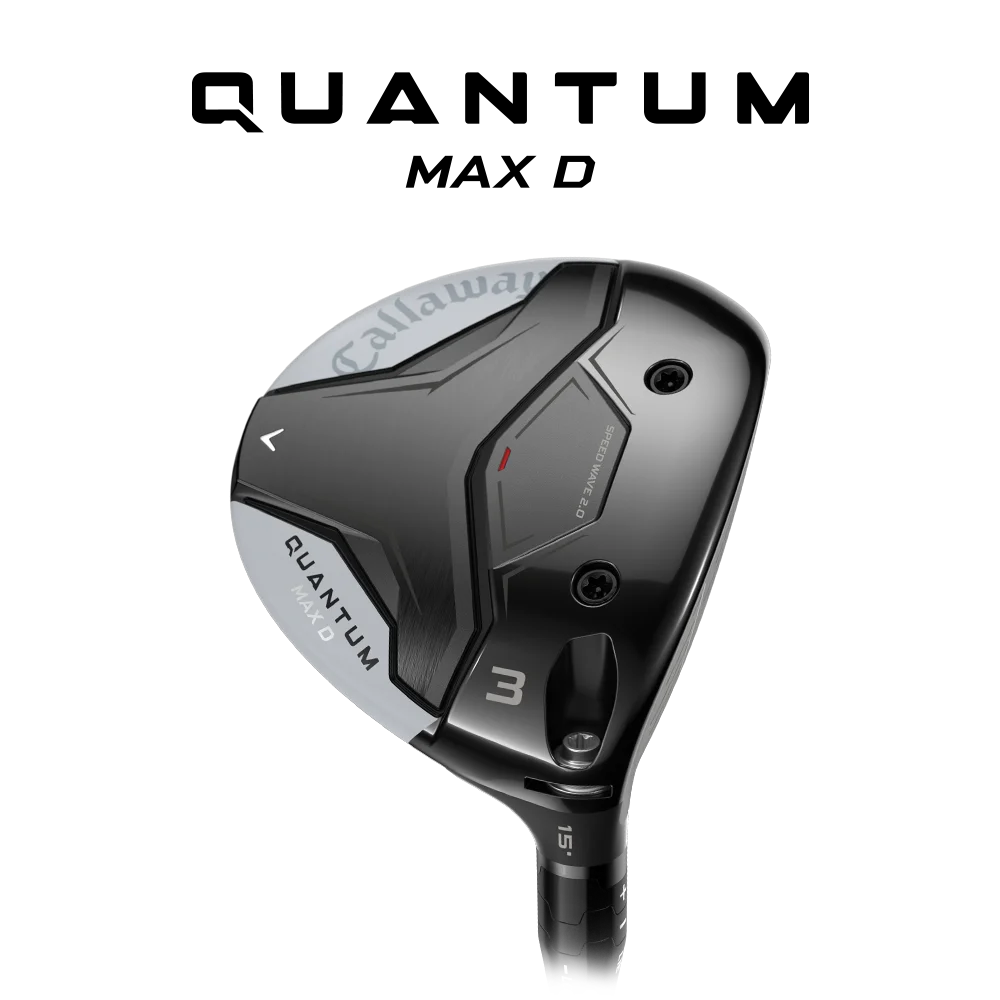
Callaway Quantum Max D Fairway Wood
The draw-biased specialist in Callaway's 2026 Quantum lineup — a 190cc oversized head with internal heel weighting ranked 3rd for forgiveness in Today's Golfer's 27-model test, delivering effortless launch and slice correction at $400.
We may earn a commission if you buy through this link — it never affects our scores or the price you pay.
The consensus
The Callaway Quantum Max D Fairway Wood is the draw-biased specialist in Callaway's 2026 Quantum lineup, built for golfers who need slice correction without sacrificing modern fairway wood technology. The 190cc oversized head — the largest in the Quantum family — combines AI FlexFace with internal heel-biased tungsten weighting (Speed Wave 2.0, 40g) to produce a natural draw tendency. Today's Golfer ranked it 3rd for forgiveness in their comprehensive 27-model fairway wood test, confirming the oversized design delivers genuine performance benefits beyond just visual confidence.
Testing data from Today's Golfer revealed 149.6 mph ball speed, 250.8 yards carry, and 2,678 rpm spin in their comparative test. The Step Sole 2.0 design improves turf interaction, while the OptiFit4 hosel provides adjustability on the 3W, 3HL, and 5W models. Golf Monthly gave it a 9/10, praising how the draw bias feels organic rather than manufactured — a key differentiation from older draw-biased designs that often felt like they were fighting the golfer's natural swing.
The primary trade-off is spin: at 4,150 rpm average, the Quantum Max D produces among the highest spin rates in the category. For slower swingers, this is a feature — the extra spin keeps the ball airborne and carrying further. For faster swingers (100+ mph), the spin becomes a liability, ballooning trajectories and costing carry distance. Dispersion was also wider than the standard Quantum Max (15.3y vs 12.7y), suggesting golfers without a slice should stick with the standard model. At $400, it's competitively priced within Callaway's lineup and the broader market.
The draw-biased specialist in Callaway's 2026 Quantum lineup — a 190cc oversized head with internal heel weighting ranked 3rd for forgiveness in Today's Golfer's 27-model test, delivering effortless launch and slice correction at $400.
Category ratings
Where to buy
Prices checked June 2026. We may earn a commission from links above at no extra cost to you.
What the community loves
The internal heel weighting produces a natural draw tendency that corrects slices without the exaggerated hook that some draw-biased clubs create. Golf Monthly praised how the draw bias feels organic rather than manufactured, and GolfWRX forum testers confirmed the slice correction works in real-world conditions.
The 190cc oversized head and low CG combine to make this one of the easiest-launching fairway woods in the 2026 class. Today's Golfer's 27-model test confirmed towering launch characteristics, particularly beneficial for slower swing speeds that struggle to get standard fairway woods airborne.
The oversized profile provides a generous footprint at address that instills confidence. Multiple reviewers noted the large head makes it feel like you can't miss — particularly valuable for higher handicappers who may feel intimidated by compact fairway wood shapes.
Draw-biased clubs often sacrifice feel quality due to extreme weight placement, but the Quantum Max D maintains Callaway's Speed Wave 2.0 tungsten system to deliver a satisfying, solid impact. Bunkered and GolfShake both noted the feel was better than expected for a draw-biased design.
Shares the AI FlexFace, Step Sole 2.0, and Speed Wave 2.0 40g tungsten from the standard Quantum Max — just repackaged with heel-biased weighting. This means you're getting Callaway's best fairway wood technology with an added draw correction layer rather than a compromised budget design.
What to watch out for
Today's Golfer measured 4,150 rpm average spin — among the highest in their 27-model test. For swing speeds above 100 mph, this excess spin balloons the ball and costs carry distance. The spin is a feature for slower swingers (helps maintain height) but a bug for faster players.
Today's Golfer recorded 15.3-yard dispersion compared to 12.7 yards for the standard Quantum Max. The draw bias adds a directional correction but slightly reduces overall consistency. Golfers who don't slice may actually see worse dispersion than with the standard model.
The built-in draw bias makes it nearly impossible to hit controlled fades, limiting versatility for better players. Multiple forum posters and reviewers emphasized this is a one-trick pony — it does that one trick well, but it's a poor choice for golfers who want to work the ball both ways.
The alignment aids and crown markings drew mixed reactions. Some golfers appreciate the visual guidance, but several forum posters found the crown too busy at address — a common complaint with draw-biased and oversized fairway woods that prioritize function over clean aesthetics.
Is it right for your game?
Forum sentiment is cautiously positive — Reddit and GolfWRX testers appreciate the draw correction for slicers, but consistently warn that the high spin (4,150 rpm) and wider dispersion (15.3y vs 12.7y for standard Max) make it a specialist tool rather than a universal fairway wood. The consensus is clear: if you slice, it works; if you don't, buy the standard Quantum Max instead.
What real people are saying
7 quotes from across the web, grouped by 4 themes. Click a theme to read the individual quotes.
Specifications
Available shafts (no upcharge)
Premium shafts available at additional cost: Graphite Design Tour AD VF, Tour AD UB, Tour AD DI
All sources analyzed
This review synthesizes opinions from 10 independent sources. Every claim on this page can be traced back to its original source. No manufacturer relationship or compensation.
The consensus score is built in four layers: raw source collection, normalization to a 0-10 scale, credibility-weighted combination, and quality adjustments.
Expert reviews (35% weight) are scored from language intensity and any numerical ratings provided. Data-driven testing (25%) converts product rank within the test group to a percentile score. Forum posts (30%) are AI-classified by sentiment, weighted by substantiveness. Retail reviews (10%) convert 5-star ratings with a 0.75x credibility discount to correct for systematic inflation.
Three quality adjustments are then applied: a source diversity bonus (up to +0.3 for coverage across all source types), a conflict penalty (up to -0.3 when sources strongly disagree), and recency weighting (recent reviews weighted higher than older ones).