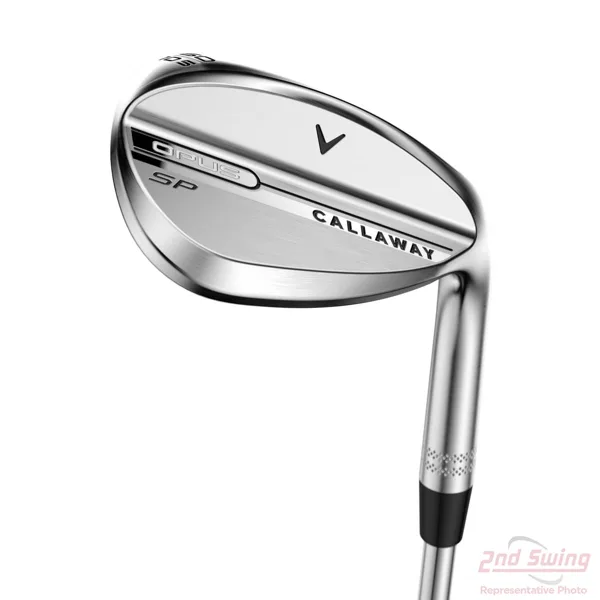
Callaway Opus SP Wedge
Callaway's most-acclaimed wedge yet — the new Spin Pocket raises the center of gravity in the 54°–60° heads to deliver a lower, more controlled flight with high, consistent spin, earning a Golf Digest 2026 Hot List Gold Medal, the fastest tour adoption in Callaway wedge history, and consensus praise from 15 sources.
We may earn a commission if you buy through this link — it never affects our scores or the price you pay.
The consensus
The Callaway Opus SP is the spin-focused follow-up to 2024's Opus, arriving for pre-sale in August 2025 and at retail that September — and it has drawn the strongest reviews of any Callaway wedge to date. Across 15 sources spanning expert reviews, panel and launch-monitor testing, forum consensus, and retail feedback, the Opus SP earns near-universal praise for spin consistency, controlled flight, and a more premium forged feel. Golf Digest awarded it a Gold Medal on the 2026 Hot List, praising a trampoline-like full-shot feel and effortless bunker pop; Today's Golfer called it the best wedge Callaway has ever made and gave it a perfect score; and National Club Golfer named it one of Callaway's very best releases ever. It also recorded the fastest tour adoption in Callaway wedge history.
Where sources agree most strongly: the Spin Pocket and the spin it produces. The Spin Pocket is a hollowed-out, low cavity in the 54°–60° heads that removes mass from the bottom of the face and relocates it higher, raising the center of gravity for a lower, more penetrating flight without sacrificing spin — a progressive design with a larger pocket in the lob wedges. Paired with the new Spin Gen 2.0 face and a sharper 17° groove angle with tighter spacing, it produced tightly clustered spin and carry numbers in testing (Golf Monthly measured roughly 7,400 rpm on 50-yard pitches), with reviewers stressing that the real gain is repeatability rather than a single peak figure. A move to a forged 1025 face on a cast body, five grinds (T, C, X, S, W) across nine lofts, six bounces, and two finishes round out a versatile, well-reviewed package.
Where the consensus fractures: forgiveness, the scope of the tech, and price. The Opus SP is unambiguously a player's wedge — Golfalot and others found it demanding around the greens, with a sole that can feel exacting on delicate shots and tight turf, and the open-faced grinds reward skilled hands only. The Spin Pocket also reaches only the 54°–60° heads, so the gap and pitching wedges are solid-bodied and miss the headline benefit, and at $199.99 (more for graphite) it sits at the top of the market — with the busier cavity look and an unusually fast replacement cycle dividing some buyers. The net: the Opus SP lands just below the Titleist Vokey SM11 (9.4) and a touch ahead of the 9.2 cluster of Cleveland RTZ, TaylorMade MG5, and RTX 6 ZipCore — a Gold-medal, tour-validated wedge that finally puts Callaway in the genuine top tier, best suited to better players who want a lower, spinnier flight and will get fit for the right grind.
Callaway's most-acclaimed wedge yet — the new Spin Pocket raises the center of gravity in the 54°–60° heads to deliver a lower, more controlled flight with high, consistent spin, earning a Golf Digest 2026 Hot List Gold Medal, the fastest tour adoption in Callaway wedge history, and consensus praise from 15 sources.
Category ratings
What the community loves
The headline technology is the Spin Pocket: a hollowed-out cavity low in the head (in the 54°–60° lofts) that removes mass from the bottom of the face and relocates it higher toward the topline, raising the center of gravity. The effect is a lower, more penetrating flight without giving up spin — exactly the launch-and-spin combination tour players chase in the scoring zone. The CG is progressive, with a larger pocket in the lob wedges, and reviewers consistently reported a flatter trajectory than the original Opus on full and partial wedge shots.
Across the coverage the recurring praise is not peak spin but how repeatable it is. The new Spin Gen 2.0 face — a deeper cross-hatch laser pattern — paired with a sharper 17° groove angle and tighter pitch spacing increases groove-edge contact, and testers reported tightly clustered spin and carry numbers. Golf Monthly measured roughly 7,400 rpm on 50-yard pitch shots on a launch monitor and singled out distance control as a strength, while Golfalot called them the most consistent wedges it has ever tested on full shots; Plugged In Golf called it some of the most consistent spin it had seen all year, holding up even on slightly thin or heel/toe strikes.
The Opus SP earned a Gold Medal on Golf Digest's 2026 Hot List, with the panel describing a highly responsive wedge with a trampoline-like full-shot feel, excellent greenside touch and spin, and effortless bunker pop. Today's Golfer named it the best wedge Callaway has ever made and gave it a perfect score, and National Club Golfer called it one of Callaway's very best releases to date. No previous Callaway wedge — including the Jaws Raw and the original Opus — has drawn this level of consensus acclaim.
Callaway called the Opus SP its best immediate conversion ever for a wedge on tour: 18 players had it in the bag in its first week out at the Memorial, and that number had climbed to 32 by the Scottish Open weeks later. Xander Schauffele, Jon Rahm, Min Woo Lee, Akshay Bhatia, and both Højgaard brothers put it into play early. That kind of rapid, voluntary adoption among elite players is one of the strongest validation signals in equipment.
The Opus SP swaps the original's all-cast head for a two-piece design — a 1025 carbon-steel forged face on an 8620 cast body — and reviewers reward it with a more responsive, communicative feel and a crisp, compact look at address. Fitting is broad: five grinds (T, C, X, S, W, running from least to most resistance to digging — the X grind is the new addition versus the original Opus), nine lofts from 48° to 64°, six bounce options, and two finishes (Chrome and Shadow Black). The X grind drew specific praise for blending bounce with a thin-feeling sole.
What to watch out for
The most-repeated caveat: the Opus SP rewards precise contact and offers very little bailout on poor strikes. Golfalot found the sole could feel too sharp and required serious precision on delicate greenside shots, particularly on tight or links turf, and Plugged In Golf flagged the open-faced S grind as one for skilled players only. That exacting nature is what better players want, but inconsistent strikers who chunk or blade wedge shots will find no help here.
The namesake technology is limited to the sand and lob wedges (54° through 60°); the 48°–52° gap and pitching wedges are solid-bodied and do not carry the Spin Pocket. Several reviewers, Today's Golfer and Golfalot among them, noted that the headline launch-and-spin benefit therefore doesn't reach the very full-swing scoring wedges where many golfers most want a lower, more controlled flight. It's a deliberate engineering choice, but it leaves part of the set out of the marketing story.
At $199.99 for steel and $209 for graphite, a three-wedge set runs close to $600 before tax, and Golfalot listed the cost outright as a weakness. The original Opus and other strong-spinning wedges from Cleveland, Mizuno, and Titleist's SM10 sit at lower price points. For recreational golfers the premium is real, especially given the Opus SP is a player-focused design rather than a forgiveness-first one.
The visible Spin Pocket cavity divides opinion — Golf Monthly noted some golfers will prefer a cleaner, more traditional muscle-back shape. The Opus SP also arrived only about ten months after the original Opus, an unusually quick turnover for a wedge line; Today's Golfer flagged the timing, and the rapid cadence can complicate value and resale for buyers who upgraded recently.
Is it right for your game?
What real people are saying
13 quotes from across the web, grouped by 6 themes. Click a theme to read the individual quotes.
Specifications
Available shafts (no upcharge)
Premium shafts available at additional cost: Graphite Design Tour AD VF, Tour AD UB, Tour AD DI
All sources analyzed
This review synthesizes opinions from 15 independent sources. Every claim on this page can be traced back to its original source. No manufacturer relationship or compensation.
The consensus score is built in four layers: raw source collection, normalization to a 0-10 scale, credibility-weighted combination, and quality adjustments.
Expert reviews (35% weight) are scored from language intensity and any numerical ratings provided. Data-driven testing (25%) converts product rank within the test group to a percentile score. Forum posts (30%) are AI-classified by sentiment, weighted by substantiveness. Retail reviews (10%) convert 5-star ratings with a 0.75x credibility discount to correct for systematic inflation.
Three quality adjustments are then applied: a source diversity bonus (up to +0.3 for coverage across all source types), a conflict penalty (up to -0.3 when sources strongly disagree), and recency weighting (recent reviews weighted higher than older ones).