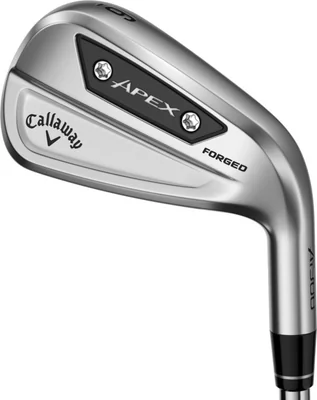
Callaway Apex Ai300 Irons
Callaway's most forgiving Apex iron ever — a forged cavity-back that delivers game-improvement forgiveness with a feel and appearance that punches well above its class. Golf Digest Hot List selection and near-universal praise across 15 sources for making distance and forgiveness accessible without sacrificing the Apex DNA.
We may earn a commission if you buy through this link — it never affects our scores or the price you pay.
The consensus
The Callaway Apex Ai300 is the most forgiving iron in the Apex family and one of the most acclaimed game-improvement irons of 2024-2025. A Golf Digest Hot List selection backed by praise across 15 sources spanning expert reviewers, forum testers, and retail feedback, the consensus is clear: this is a forged iron that delivers forgiveness and distance without the typical trade-offs in feel and appearance. The cavity-back construction pairs a forged 1025 carbon steel body with a forged 455 face cup, producing impact quality that multiple reviewers said rivals players irons despite the larger, more forgiving head profile.
Where sources agree most strongly: forgiveness and feel. Plugged In Golf said these irons were made for golfers who wanted Apex quality but needed more help on mishits. Today's Golfer recorded a 186-yard 7-iron carry with peak height of 30 yards, noting shots that missed the center still found playable results. On the feel front, GolfWRX's launch report highlighted the soft impact that lets you feel the ball compress off the face, while National Club Golfer's 14-handicap tester was sold after just a few warm-up shots. The Ai Smart Face uses machine learning to optimize speed and spin consistency across the hitting area, producing tighter dispersion than typical game-improvement irons.
Where the consensus fractures: aesthetics and workability. The Ai300's thicker topline and visible offset earned mixed reactions. Mid-to-high handicappers found the larger profile confidence-inspiring, while lower-handicap testers noted the step from the Ai200 is visible at address. The strong 29-degree 7-iron loft produces impressive distance but lower spin rates in the mid-4000 RPM range, which means approach shots on firm greens may roll out more than expected. For golfers in the 9-to-25 handicap range who want premium forged feel without demanding perfect strikes, the Ai300 is one of the strongest options in the 2025 game-improvement class. If you need shot-shaping versatility or a compact address profile, the Ai200 is the better choice within the Apex family.
Callaway's most forgiving Apex iron ever — a forged cavity-back that delivers game-improvement forgiveness with a feel and appearance that punches well above its class. Golf Digest Hot List selection and near-universal praise across 15 sources for making distance and forgiveness accessible without sacrificing the Apex DNA.
Category ratings
What the community loves
The defining trait of the Ai300 across nearly every source. The larger head profile, wider sole, and strategically placed MIM tungsten weighting produce stability on off-center strikes that multiple reviewers described as exceptional for a forged iron. Today's Golfer noted shots hit off-toe still landed on the green edge without excessive pullback. Golfstead measured forgiveness approaching Paradym Ai Smoke levels. Forum testers reported that fat and thin strikes produced playable results rather than disaster shots.
The strongest emotional response across reviewers. The forged 1025 carbon steel body paired with the forged 455 face cup produces impact quality that multiple sources said rivals traditional players irons. GolfWRX's launch report highlighted the soft feel at impact with the ability to feel ball compression off the face. National Club Golfer praised the tour-level sound and feel despite the larger head size. Urethane Microspheres dampen unwanted vibration without killing feedback.
The low CG placement, strong lofts, and forged 455 face cup combine to produce high-launching, distance-producing shots with minimal effort. Today's Golfer recorded a 7-iron carry of 186 yards with peak height of 30 yards in testing. Multiple sources noted the ball flight was noticeably higher than expected, producing steep descent angles that hold greens despite the strong lofts. Golfer Geeks rated distance a perfect 5/5.
The AI-optimized face design uses real golfer swing data to minimize speed and spin variation across the hitting area. Multiple reviewers noted that the Ai300 produces tighter dispersion than expected for a game-improvement iron — off-center strikes maintain trajectory and distance rather than ballooning or dropping short. GolfWRX highlighted the technology's ability to reduce hot spots while maintaining speed across the face.
The cavity-back design looks sophisticated from behind the ball, with a satin chrome finish that earned shelf-appeal praise across sources. Golf Monthly specifically noted the Ai300 offers a strong blend of players-iron looks from the back while providing confidence-inspiring size at address. National Club Golfer reported the head did not feel overly bulky despite its larger profile. The Apex branding and clean lines elevate the iron beyond typical game-improvement aesthetics.
The Dynamic Sole Design produces smooth ground contact from fairway, rough, and tight lies. Multiple reviewers noted clean divots and minimal tendency to dig or bounce. Today's Golfer and Plugged In Golf both highlighted that the wider sole provides stability through the turf without creating chunked shots — a key benefit for the target demographic of mid-to-high handicappers who may not always find the center of the strike zone on the ground.
What to watch out for
At 29 degrees for the 7-iron, the Ai300 runs strong lofts that generate distance partly through reduced spin. Golfstead measured mid-4000 RPM range with the 7-iron — lower than traditional irons. While the high launch angle partially compensates with steeper descent, some reviewers noted approach shots on firm greens may roll out more than expected. Players transitioning from weaker-lofted irons should expect to recalibrate approach distances.
The Ai300 sits at the premium end of the game-improvement category. Today's Golfer flagged the slightly higher price point compared to competitors. At this price, golfers can also consider the Cleveland Launcher XL Halo, TaylorMade Qi Max, or Ping G440 irons, which offer similar forgiveness at lower entry points. The forged construction justifies some premium, but value-conscious buyers may feel the technology gap does not match the price gap.
The offset, draw bias, and larger head make intentional shot shaping difficult. Golfstead specifically noted limited shot-shaping ability as a downside. The iron is engineered to fly high and straight, which is exactly what the target player wants — but better players who occasionally need to work the ball may find the Ai300 too resistant to manipulation. This is by design, not a flaw, but worth noting for golfers considering moving down from players irons.
The visual profile at address is noticeably larger than the Ai200, with a thicker topline and more offset. Golf Monthly listed the relatively heavy offset as a con. Plugged In Golf noted the step toward game improvement is visible side-by-side with the Ai200. Better players who prioritize a clean, compact address view may find the Ai300 too chunky despite its premium finish.
Is it right for your game?
Sources overwhelmingly agree on forgiveness and feel — the Ai300 delivers premium forged impact quality with game-improvement-level mishit protection. The split is on aesthetics and workability: mid-to-high handicappers love the confidence-inspiring size, while lower-handicap testers find the offset and thicker topline a step too far from the Ai200's compact profile. If you want maximum forgiveness in a forged iron with Apex DNA, this is the one. If you need shot-shaping ability, look at the Ai200.
What real people are saying
23 quotes from across the web, grouped by 8 themes. Click a theme to read the individual quotes.
Specifications
Available shafts (no upcharge)
Premium shafts available at additional cost: Graphite Design Tour AD VF, Tour AD UB, Tour AD DI
All sources analyzed
This review synthesizes opinions from 15 independent sources. Every claim on this page can be traced back to its original source. No manufacturer relationship or compensation.
The consensus score is built in four layers: raw source collection, normalization to a 0-10 scale, credibility-weighted combination, and quality adjustments.
Expert reviews (35% weight) are scored from language intensity and any numerical ratings provided. Data-driven testing (25%) converts product rank within the test group to a percentile score. Forum posts (30%) are AI-classified by sentiment, weighted by substantiveness. Retail reviews (10%) convert 5-star ratings with a 0.75x credibility discount to correct for systematic inflation.
Three quality adjustments are then applied: a source diversity bonus (up to +0.3 for coverage across all source types), a conflict penalty (up to -0.3 when sources strongly disagree), and recency weighting (recent reviews weighted higher than older ones).