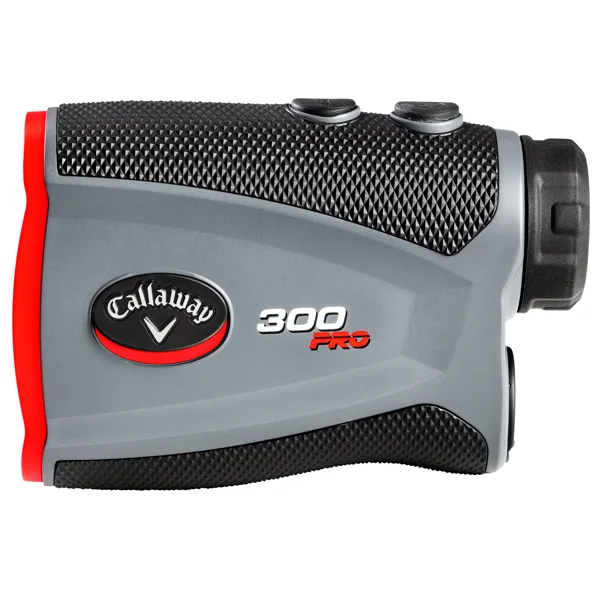
Callaway 300 Pro Laser Rangefinder
The long-running value benchmark of the laser-rangefinder category — the Callaway 300 Pro packs a near-flagship feature list (Slope, a Magnahold cart magnet, P.A.T. pin-lock with vibration, and a scan mode) into a compact ~$200 body, and reviewers keep reaching the same verdict: top-tier features for budget money. It nails the things that actually matter to most golfers — repeatable ±1-yard accuracy inside normal range, fast confirmed pin-lock, and dead-simple two-button operation — while honest knocks pile up on its weaker spots: a basic LCD that's hard to read in glare or low light, optimistic long-range claims, and water-resistant-not-waterproof construction. Synthesized from 11 sources (expert reviews, community, and retail; the data is thin — it sits below the flagship lab tests, not in them), it earns a solid value-tier consensus with Value as its standout dimension.
We may earn a commission if you buy through this link — it never affects our scores or the price you pay.
The consensus
The Callaway 300 Pro is the rangefinder market's long-running value benchmark — the unit that, for years, has answered the question 'what do I buy if I want a real slope rangefinder but not a $400–$600 one?' It pairs a near-flagship feature list (Slope with a 'plays-like' yardage, a Magnahold cart magnet, P.A.T. pin-lock with vibration and an audible 'Birdie' chirp, a scan mode, and an external tournament-legal slope toggle) with a compact ~$200 body that frequently dips lower on sale. Across 11 sources spanning expert reviews, community feedback, and retail ratings, it earns a solid value-tier consensus — with the important context that the data here is thin: the 300 Pro sits below the rigorous flagship accuracy-and-speed lab tests rather than inside them, so the case rests on consistent reception more than a controlled head-to-head ranking.
Where sources agree most strongly: value, real-world accuracy, pin-lock, and simplicity. Reviewers repeatedly frame it as features-of-a-$300-unit for budget money — Vision Quest Golf called it 'our top value pick for 2025,' Critical Golf made it a 'Best Compact' pick, and Golfers Authority said it 'doesn't feel like Callaway's initial rangefinder.' Inside normal golf range the ±1-yard readings come back the same time after time (the trait cheap no-name units fail), the P.A.T. lock fires quickly and confirms with a buzz and a chirp, and the two-button, instant-wake operation makes it one of the easiest rangefinders to pick up and use. Pro Golf Insider's takeaway captures the tone: it 'delivers reliable distances and useful features without a steep price tag.'
Where the consensus is honest about limits: the display, the reach, and the build. The basic LCD reticle is the most-cited knock — hard to read against bright glare or in fading light — and the '300-yard flag' name oversells it, with reliable flag-lock landing closer to 250–275 yards and occasional struggles acquiring low-contrast targets. It's water- and fog-resistant rather than fully waterproof, leans on a less-common CR2 battery, and a few long-term owners report reliability slipping after about a year. None of that undoes the value proposition; it just frames it honestly. For a budget-conscious buyer, a casual golfer, or a first rangefinder, the 300 Pro is exactly what its years of value recommendations say it is — a trustworthy, simple, feature-rich slope unit that punches well above its price. Players who want premium optics, confident long-range locks, or the most-validated numbers should step up to a flagship.
The long-running value benchmark of the laser-rangefinder category — the Callaway 300 Pro packs a near-flagship feature list (Slope, a Magnahold cart magnet, P.A.T. pin-lock with vibration, and a scan mode) into a compact ~$200 body, and reviewers keep reaching the same verdict: top-tier features for budget money. It nails the things that actually matter to most golfers — repeatable ±1-yard accuracy inside normal range, fast confirmed pin-lock, and dead-simple two-button operation — while honest knocks pile up on its weaker spots: a basic LCD that's hard to read in glare or low light, optimistic long-range claims, and water-resistant-not-waterproof construction. Synthesized from 11 sources (expert reviews, community, and retail; the data is thin — it sits below the flagship lab tests, not in them), it earns a solid value-tier consensus with Value as its standout dimension.
Category ratings
What the community loves
The 300 Pro's whole identity is value, and every source lands on it. For roughly $200 — and frequently less on sale — you get Slope, a Magnahold cart magnet, P.A.T. pin-lock with vibration, a scan mode, and a tournament-legal slope toggle, a stack that mostly belonged to $300-plus rangefinders. Vision Quest Golf called it 'top-tier features usually found in $300+ rangefinders … our top value pick for 2025,' and Golfers Authority went so far as to say it 'doesn't feel like Callaway's initial rangefinder.' For the golfer who wants the features without the flagship price, nothing about the spec sheet feels cut down.
The single most important thing a budget rangefinder has to do is give the same number twice — and reviewers consistently say the 300 Pro does. Shooting a flag repeatedly returns near-identical readings within its advertised one-yard tolerance, the trait that separates it from cheaper no-name units that drift a few yards each pull. Pro Golf Insider found distances stayed 'consistent within one yard for shots under 300 yards,' and Golfers Authority reported its slope math tracked a $600 Bushnell within two to three yards on elevation changes. Inside the range most golfers actually play, the number is trustworthy.
Pin Acquisition Technology locks the flag quickly and tells you about it twice: a short vibration pulse plus a 'Birdie' chirp on acquisition, so you know you've grabbed the stick and not the trees behind it. Reviewers say it works through light foliage and in light rain, and Golfers Authority noted it lands the flag on the first try the large majority of the time — a night-and-day improvement over older units that needed several attempts. For most rounds, the lock is fast and the confirmation is reassuring.
There is almost nothing to learn. Instant wake-up, two buttons — one fires the laser, the other switches yards/meters and toggles slope — and no apps, pairing, or menus to fight. Pro Golf Insider summed up the controls as 'power button turns it on and fires the laser; mode button switches between yards/meters and toggles slope — that's it,' and Golf Review Guy noted it's ready 'right out of the box.' For a first rangefinder or a player who just wants a number, the lack of complication is a genuine feature.
At roughly 5.4 oz and palm-sized, the 300 Pro is one of the easier units to pocket and to hold steady — Critical Golf made portability the basis of its 'Best Compact' pick, writing that 'the size is what stood out to me the most; it fit in the palm of your hand.' The integrated Magnahold magnet snaps it to the cart frame between shots, and an included molded hard case protects it in the bag. It's an easy unit to carry and an easy one to keep within reach.
What to watch out for
The 300 Pro uses a basic LCD reticle rather than the bright, switchable red/black displays of pricier rangefinders, and reviewers repeatedly flag it as the weak point. Vision Quest Golf found the display 'difficult to read in bright sunlight,' and Pro Golf Insider reported visibility 'suffers in low-light conditions' at dusk or dawn. It's legible in normal daylight, but against a washed-out sky or in fading light the numbers can be hard to pick out — the clearest place the budget price shows.
The '300-yard flag' name oversells the reach. Multiple reviewers found flag-lock most reliable inside roughly 250–275 yards, with 300-yard pins sometimes needing several attempts, and the optics and acquisition can struggle on low-contrast or distant targets. MyGolfSpy forum members noted it 'might occasionally struggle to acquire a target before locking on.' For the yardages that matter on most approach shots it's solid, but it isn't the tool for confidently lasering very long or hard-to-find targets.
Callaway markets the unit as water- and fog-resistant, but it carries no published waterproof (IP) rating, so it's built to shrug off rain rather than survive a dunk. A handful of long-term owners report reliability slipping after about a year, the CR2 lithium battery is less common than the AAA/CR2032 cells some rivals use, and an aggressive ~10-second auto-shutoff means you'll re-wake it often. None are dealbreakers at the price, but they're real reminders this is a value unit, not a buy-once flagship.
The 300 Pro is a long-running design, and it shows: no GPS, no app, no temperature/altitude/wind 'plays-like' brain, no premium glass, and a display a generation behind the best. It also sits outside MyGolfSpy's rigorous flagship accuracy-and-speed test (which anchors the premium units), so the rich head-to-head data that backs a Bushnell Pro X3+ simply doesn't exist for it — the case here rests on consistent expert and owner reception rather than a controlled lab ranking. Buyers chasing the latest tech or the most-validated numbers will look elsewhere.
Is it right for your game?
What real people are saying
10 quotes from across the web, grouped by 5 themes. Click a theme to read the individual quotes.
Specifications
All sources analyzed
This review synthesizes opinions from 11 independent sources. Every claim on this page can be traced back to its original source. No manufacturer relationship or compensation.
The consensus score is built in four layers: raw source collection, normalization to a 0-10 scale, credibility-weighted combination, and quality adjustments.
Expert reviews (35% weight) are scored from language intensity and any numerical ratings provided. Data-driven testing (25%) converts product rank within the test group to a percentile score. Forum posts (30%) are AI-classified by sentiment, weighted by substantiveness. Retail reviews (10%) convert 5-star ratings with a 0.75x credibility discount to correct for systematic inflation.
Three quality adjustments are then applied: a source diversity bonus (up to +0.3 for coverage across all source types), a conflict penalty (up to -0.3 when sources strongly disagree), and recency weighting (recent reviews weighted higher than older ones).