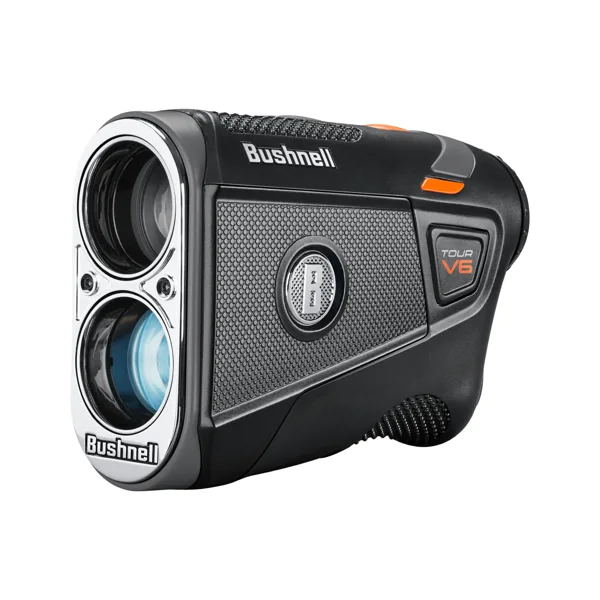
Bushnell Tour V6 Laser Rangefinder
The tournament-legal, no-slope member of Bushnell's Tour V6 family — and one of the best value plays in lasers. It shares its chassis, IPX6 build, BITE magnet and Visual-JOLT pin-lock with the more expensive V6 Shift and tests within inches of Bushnell's flagship Pro X3+, but drops slope (and the price) for the player who wants a fast, dead-accurate yardage that's legal in competition. Synthesized from 14 sources, it earns a strong consensus as a 'flagship feel without the flagship features' pick at $299.99 — the recurring caveats being its 6x (not 7x) optics, its deliberately feature-light spec, and that it's a late-cycle model now being overtaken by the OLED Tour V7 Shift.
We may earn a commission if you buy through this link — it never affects our scores or the price you pay.
The consensus
The Bushnell Tour V6 is the tournament-legal, no-slope member of Bushnell's mid-range Tour family — and one of the better value plays in the laser-rangefinder market. It shares its chassis, IPX6 weatherproofing, BITE magnetic mount and Visual-JOLT pin-lock with the more expensive V6 Shift (the only difference between the two is slope), and in head-to-head testing it ranges within inches of Bushnell's $599.99 flagship Pro X3+. What it drops is the price and the features a competitive player can't legally use: at $299.99 it gives you the flagship's accuracy, speed and build without slope, wind or GPS. Synthesized from 14 sources — two instrumented tests, seven expert reviews (several of the V6 Shift, which is mechanically identical), forum chatter and retail feedback — it earns a strong, broadly consistent consensus.
Where sources agree most strongly: accuracy, speed, build and value. Golf Insider's instrumented test handed the V6 a perfect 100/100 for accuracy — zero error across its 50–200 yard targets and the second-most accurate unit it measured — while MyGolfSpy reported readings 'within inches of the intended target.' Reviewers love the fast, confident lock with Visual JOLT (Golfers Authority clocked it acquiring targets 'in less than a second'), the premium IPX6 chassis with its unusually strong BITE magnet (Plugged In Golf's Matt Saternus jokes you 'could probably throw the V6 at your cart and it would stick'), and the dead-simple two-button operation. PlayBetter rates the build as rivaling 'even the mighty Pro X3+,' and Breaking Eighty's Pro X3-owning playing partner liked the V6 hardware enough to offer to trade his flagship for it.
Where the consensus is honest about limits: optics, feature set, and timing. The V6 stops at 6x magnification (premium rivals run 7x) and uses a black LCD reticle that can wash out in flat light rather than an illuminated or OLED display. It's also deliberately feature-light — no slope, no 'plays-like' math, no GPS — so the casual golfer who actually wants elevation-adjusted yardages should step up to the V6 Shift (+$100) or the Pro X3+. And it's a late-cycle model: Bushnell has launched the dual-color OLED Tour V7 Shift, the V6 was an incremental step to begin with (Golfalot's Dan Box calls it 'evolution, not revolution'), and budget rivals match the core point-and-click experience for less. But for the competitive player who wants a conforming laser, or the value buyer who wants flagship accuracy and build without paying for slope, the Tour V6 is exactly what its consensus says: a lot of Pro X3+ for half the money.
The tournament-legal, no-slope member of Bushnell's Tour V6 family — and one of the best value plays in lasers. It shares its chassis, IPX6 build, BITE magnet and Visual-JOLT pin-lock with the more expensive V6 Shift and tests within inches of Bushnell's flagship Pro X3+, but drops slope (and the price) for the player who wants a fast, dead-accurate yardage that's legal in competition. Synthesized from 14 sources, it earns a strong consensus as a 'flagship feel without the flagship features' pick at $299.99 — the recurring caveats being its 6x (not 7x) optics, its deliberately feature-light spec, and that it's a late-cycle model now being overtaken by the OLED Tour V7 Shift.
Category ratings
What the community loves
Accuracy is the Tour V6's headline, and it punches well above its $299.99 sticker. Golf Insider's instrumented test scored it a perfect 100/100 — zero error across 50–200 yard targets and the second-most accurate unit they tested — while MyGolfSpy reported readings 'within inches of the intended target' and praised its consistency. Several reviewers note it returns the same number on repeated pulls at the same spot, a step up from the V5. For a tool whose only job is a number you can trust, getting flagship-class repeatability without paying flagship money is the V6's core appeal.
The V6 is genuinely quick — reviewers describe the yardage appearing the instant you release the button, with PinSeeker and Visual JOLT pairing a flashing red ring with a vibration pulse so you know you've caught the flag and not the trees. Golfers Authority clocked it 'locking onto targets in less than a second,' and Golf Insider rated locking speed 92/100, calling it 'quick, and sharp.' Golfalot adds that it 'picks up the flag quickly and easily, even when you aren't holding it completely steady.' Speed plus unmistakable lock confirmation is exactly what most golfers want from a laser.
The V6 shares the Tour family's premium chassis: rubber-armored housing, an IPX6 weather rating Bushnell calls its 'most weather-resistant Tour-series laser ever,' and an integrated BITE magnet for the cart bar. Matt Saternus (Plugged In Golf) calls it 'the kind of premium laser we expect from Bushnell' and jokes the magnet is so strong 'you could probably throw the V6 at your cart and it would stick.' PlayBetter goes further, rating the build quality as rivaling 'even the mighty Pro X3+.' Golf Insider's 93/100 build score and survive-the-rain field testing back up the buy-once durability story.
There's almost no learning curve. Golf Insider rated ease of use 95/100, describing it as 'simple' with intuitive toggling between scan and PinSeeker modes; the secondary button handles yard/meter and brightness and that's the whole interface. No phone pairing is required for the core yardage, no slope settings to think about, nothing to misconfigure on the first tee. For the player who just wants to point, click, and hit, that minimalism is a feature, not a shortcoming.
The whole point of the base V6 is that it has no slope, so it's conforming to the Rules of Golf right out of the box — no slope-switch to flip, nothing for a rules official to question. PlayBetter frames it as 'an outstanding savings opportunity for those golfers who aren't interested in slope-adjusted yardages,' and Sean Ogle's Pro X3-owning playing partner liked the V6 hardware enough to say he'd trade his flagship for it. For a competitive player, you're buying the accuracy, speed and build of a flagship and paying nothing for features you legally couldn't use.
What to watch out for
Where the Pro X3+ and several premium rivals run 7x magnification, the V6 stops at 6x through a 24mm objective, and it uses a black LCD reticle rather than the dual-color or red OLED displays of pricier lasers. Reviewers still call the view 'bright' and 'clear' — Golf Insider scored optics 90/100 — but Sean Ogle flags 'minor viewfinder alignment difficulties,' and the black crosshair can wash out against dark backgrounds or in flat, low light. It's a good display, not a class-leading one.
Accuracy and speed are elite, but the base V6 does one thing: distance. There's no slope, no 'plays-like' Elements math, no wind, no GPS overlay — MyGolfSpy specifically notes it 'lacks some of the features that other sub-$300 rangefinders have, including slope.' For competitive players that's exactly the point, but the casual golfer who actually wants elevation-adjusted yardages has to step up to the V6 Shift (+$100) or the Pro X3+. Buy the V6 for what it deliberately leaves out, not in spite of it.
The V6 is near the end of its run. Bushnell has launched the dual-color OLED Tour V7 Shift as the family's new flagship, the V6 is frequently out of stock on Bushnell's own site, and reviewers were candid that it was an incremental step to begin with: Dan Box (Golfalot) calls it 'evolution, not revolution' and says if you own a recent Bushnell, 'I'm not sure it's worth upgrading.' The upside is that end-of-cycle status means real discounts; the downside is you're buying last-generation hardware (no OLED, no launch-monitor connectivity) just as its replacement arrives.
You pay a Bushnell-brand premium. Matt Saternus is blunt that competitors offer 'almost all these features for half the price,' and forum buyers regularly point first-time shoppers toward sub-$200 units (Vortex, Nexus, Gogogo and the like) that deliver a comparable point-and-click yardage with JOLT-style vibration. The V6 earns its keep on build quality, optics polish and resale/tour pedigree — but if your priority is purely the cheapest reliable number, it isn't the value floor.
Is it right for your game?
What real people are saying
12 quotes from across the web, grouped by 6 themes. Click a theme to read the individual quotes.
Specifications
All sources analyzed
This review synthesizes opinions from 14 independent sources. Every claim on this page can be traced back to its original source. No manufacturer relationship or compensation.
The consensus score is built in four layers: raw source collection, normalization to a 0-10 scale, credibility-weighted combination, and quality adjustments.
Expert reviews (35% weight) are scored from language intensity and any numerical ratings provided. Data-driven testing (25%) converts product rank within the test group to a percentile score. Forum posts (30%) are AI-classified by sentiment, weighted by substantiveness. Retail reviews (10%) convert 5-star ratings with a 0.75x credibility discount to correct for systematic inflation.
Three quality adjustments are then applied: a source diversity bonus (up to +0.3 for coverage across all source types), a conflict penalty (up to -0.3 when sources strongly disagree), and recency weighting (recent reviews weighted higher than older ones).