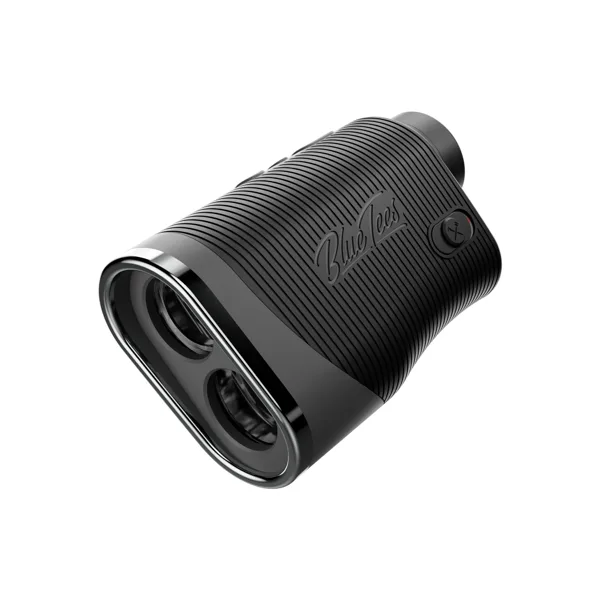
Blue Tees Series 3 Max+ Laser Rangefinder
Blue Tees' current S3 flagship and one of the most-recommended rangefinders under $200 — the Series 3 Max+ is the USB-C-rechargeable successor to the Series 3 Max, wrapping a magnet-equipped, slope-switch package in a premium-feeling shell with a crisp Red/Black HD display, and it earns warm reviews for fast pin acquisition and standout value. The honest caveat is accuracy at range: it's dependable inside ~150 yards, but MyGolfSpy's 24-unit test ranked it 18th of 24 for accuracy (14th overall), and several testers note it grabs the background on longer or low-contrast flags. Across 13 sources it lands a solid value-tier consensus — a lot of rangefinder for the money, just not the locked-in precision of the premium field.
We may earn a commission if you buy through this link — it never affects our scores or the price you pay.
The consensus
The Blue Tees Series 3 Max+ is the current flagship of Blue Tees' best-selling S3 laser line and the direct successor to the Series 3 Max. The headline upgrades are practical rather than flashy: an internal USB-C rechargeable battery in place of a disposable CR2, a more ergonomic shell, and faster internal electronics — wrapped around the same core proposition that made the brand a phenomenon, namely a near-complete feature set at a budget price. For about $199 (a $269 list that's almost always on sale) you get a tournament-legal Slope Switch, Advanced Flag Lock with pulse vibration, a strong dual-plate cart magnet, and a clean Red/Black HD display. Across 13 sources — independent testing, expert review, forums and retail feedback — it earns a solid value-tier consensus.
Where reviewers agree most strongly is value, speed and presentation. Breaking Eighty's Sean Ogle calls it 'the best rangefinder you can get under $200'; Golf Monthly's Joel Tadman describes 'a premium looking and performing laser rangefinder without the punchy price' and a 'beautifully clear' display; and Independent Golf Reviews' Ryan Heiman found it 'very quick from cart to knowing the distance' and 'one of the better lasers on the market.' The USB-C battery, the genuinely strong cart magnet, and the easy slope toggle come up again and again as the features that make it feel more expensive than it is — GolferHive goes so far as to say it delivers '95% of the performance of a high-end Bushnell at a fraction of the cost.'
Where the consensus is honest about limits is accuracy at range and outright build. MyGolfSpy's 24-unit test is the dissenting data point: the Series 3 Max finished 18th of 24 for accuracy and 14th overall, with testers noting 'the pin-seeker technology does not grab the pin quite as well as it should, and you have a hard time trusting the number.' Golf Insider measured roughly 0-2 yards of error, worst in the 100-200 yard band, and several reviewers note the flag-lock occasionally reads the background on long or low-contrast pins. The 6x optics are average, the body is rated IPX4 rather than fully submersible, and Breaking Eighty found the polish hides a still-budget feel. The verdict that emerges is consistent: for the golfer who wants a fast, full-featured, modern rangefinder and rarely needs a locked-in number past 150 yards, the Series 3 Max+ is a lot of device for the money — just not the precision instrument the premium field is.
Blue Tees' current S3 flagship and one of the most-recommended rangefinders under $200 — the Series 3 Max+ is the USB-C-rechargeable successor to the Series 3 Max, wrapping a magnet-equipped, slope-switch package in a premium-feeling shell with a crisp Red/Black HD display, and it earns warm reviews for fast pin acquisition and standout value. The honest caveat is accuracy at range: it's dependable inside ~150 yards, but MyGolfSpy's 24-unit test ranked it 18th of 24 for accuracy (14th overall), and several testers note it grabs the background on longer or low-contrast flags. Across 13 sources it lands a solid value-tier consensus — a lot of rangefinder for the money, just not the locked-in precision of the premium field.
Category ratings
What the community loves
Value is the Series 3 Max+'s entire reason for being, and it's the single most-repeated praise across reviews. At a $269 list that's almost always discounted to $199, it bundles slope, a strong cart magnet, pulse-vibration flag lock and a USB-C rechargeable battery — features that cost $400-plus elsewhere. Breaking Eighty's Sean Ogle flatly calls it 'the best rangefinder you can get under $200,' and Golf Insider's Will Shaw notes that 'for $199, the Blue Tees Series 3 Max offers really good value.' For a first rangefinder or a budget upgrade, the price-to-feature ratio is hard to beat.
Reviewers consistently describe the Max+ as quick from raise-to-number, with the Advanced Flag Lock firing a short vibration burst the moment it locks a target. Independent Golf Reviews' Ryan Heiman found it 'very quick from cart to knowing the distance,' and GolferHive describes the locking speed as 'nearly instant' with a 'confident vibrating buzz.' For everyday on-course use inside normal approach ranges, the acquisition speed feels genuinely premium.
The headline change from the Series 3 Max is power: the Max+ swaps the disposable CR2 for an internal USB-C rechargeable battery, so you top it up from a cart port or a car charger and skip buying cells. Reviewers report 6-15 rounds per charge with no noticeable drain mid-round, and Independent Golf Reviews highlights the 'more ergonomic external shell' and faster internal electronics as the meaningful generational upgrades. It's a modern, low-maintenance package.
An external Slope Switch toggles elevation-adjusted 'plays-like' yardages on and off, so the device is legal for competition with a flip — Golf Monthly's Joel Tadman praises how easily it switches via the side button. The built-in dual magnetic plates are a recurring favorite: GolferHive says the mount 'holds 99% of rounds' on a cart frame, and Independent Golf Reviews notes the magnet is strong enough to prevent movement over rough terrain. For the feature checklist most golfers actually want, the Max+ ticks the boxes.
For a sub-$200 unit, the Max+ punches above its price on presentation. Golf Monthly calls it 'a premium looking and performing laser rangefinder without the punchy price' and singles out the 'beautifully clear' display, and the Red/Black HD readout (auto-adjusting for lighting) was the Series 3 Max's strongest category in MyGolfSpy's test, finishing 8th of 24. The packaging, hardshell case and overall fit-and-finish read more expensive than the receipt.
What to watch out for
The Max+ advertises ±1 yard, but independent testing tells a more nuanced story. MyGolfSpy ranked the Series 3 Max 18th of 24 for accuracy (14th overall) and reported that 'the pin-seeker technology does not grab the pin quite as well as it should, and you have a hard time trusting the number.' Golf Insider measured '0 to 2 yards of error,' worst in the 100-200 yard band. It's dependable inside about 150 yards; beyond that, precision-minded players will notice it isn't a Bushnell.
Tied to the accuracy point, several reviewers note the flag-lock can read the trees or backdrop behind a distant or low-contrast pin rather than the pin itself. Golf Insider observes the Flag Lock 'does pick the background up a little more often than the best rangefinders,' and GolferHive pegs reliable flag-lock at roughly 300 yards rather than the headline maximum. A re-shot usually fixes it, but it costs you the instant, one-and-done confidence the premium units deliver.
The 6x glass is fine, not special. Breaking Eighty's Sean Ogle says 'the display on the Blue Tees device felt lacking' next to premium models, and GolferHive flags that the black LCD can be hard to read in direct sun or deep shadow. The view is perfectly usable in normal conditions, but it doesn't have the brightness or edge-to-edge clarity of pricier rivals, and the magnification stops at 6x where some competitors offer 7x.
It looks premium, but a few long-term notes temper the impression. Breaking Eighty had a trim piece fall off after about 18 months and describes the unit as still feeling 'like a budget device' under the polish, and Blue Tees rates the body IPX4 (splash/rain-resistant) rather than the fully-submersible IPX7 of flagship lasers. The case's elastic magnetic strap is also a recurring minor gripe (Golf Monthly: it 'often comes loose'). Fine for fair-weather golf; less reassuring in a downpour.
Is it right for your game?
What real people are saying
12 quotes from across the web, grouped by 6 themes. Click a theme to read the individual quotes.
Specifications
All sources analyzed
This review synthesizes opinions from 13 independent sources. Every claim on this page can be traced back to its original source. No manufacturer relationship or compensation.
The consensus score is built in four layers: raw source collection, normalization to a 0-10 scale, credibility-weighted combination, and quality adjustments.
Expert reviews (35% weight) are scored from language intensity and any numerical ratings provided. Data-driven testing (25%) converts product rank within the test group to a percentile score. Forum posts (30%) are AI-classified by sentiment, weighted by substantiveness. Retail reviews (10%) convert 5-star ratings with a 0.75x credibility discount to correct for systematic inflation.
Three quality adjustments are then applied: a source diversity bonus (up to +0.3 for coverage across all source types), a conflict penalty (up to -0.3 when sources strongly disagree), and recency weighting (recent reviews weighted higher than older ones).